They gave $50,000 last year. They care deeply about the program. They told their gift officer they want to stay involved. And then, for eight months, nobody called them.
They are not neglected because your team does not care. They are neglected because your gift officers are managing 150 prospects each, your major donors were pulled out of mass communications to avoid “over-solicitation,” and nobody built a system for what happens between the thank-you letter and the next ask. The result is a stewardship gap that costs institutions millions in lapsed major gifts and eroded relationships every year.
The Portfolio Purgatory Problem
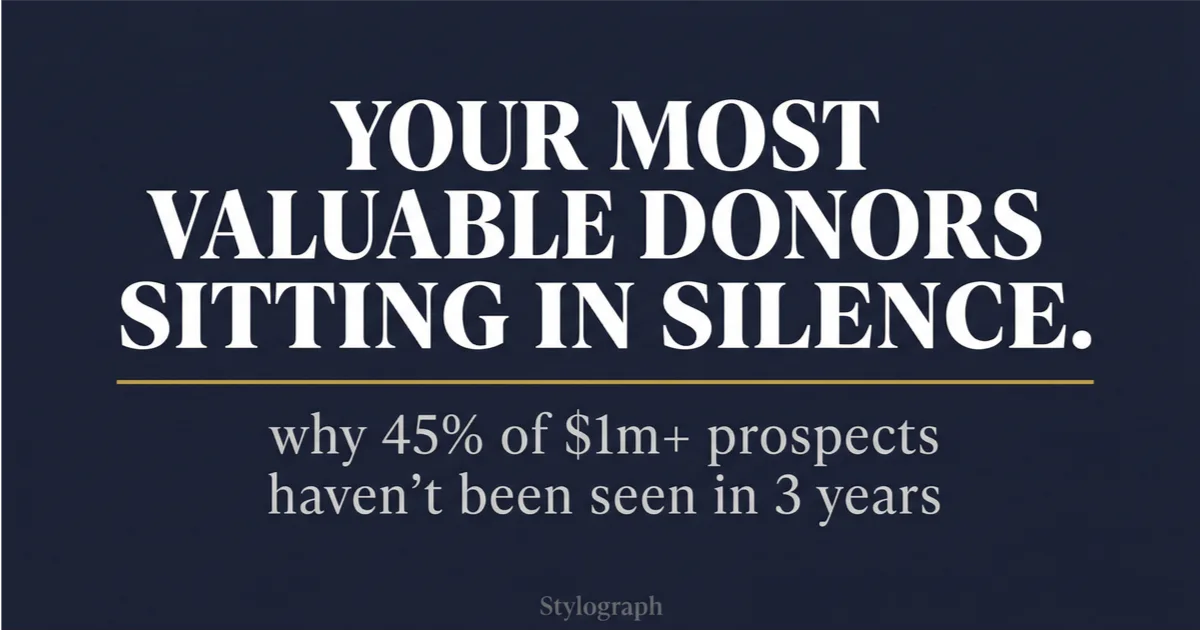
At Northwestern University, David Lively evaluated portfolio data across 17 major gift officers and found a pattern that will sound familiar to every VP of advancement reading this: 45 percent of managed prospects with capacity to give over $1 million had not been seen in three years. For six-figure capacity prospects, the number was 55 percent. And 65 percent of all prospects in those portfolios had not been visited over the course of a full fiscal year.
The cruelest dimension of this pattern is that it creates a worse donor experience for your best prospects than for your $100 annual fund donors. Because these individuals were assigned to a gift officer, they were removed from alumni event invitations and mass annual appeals. The institution considered them “too special” for bulk outreach. But to those donors? Silence. They received less communication than someone who gave a fraction of what they gave.
This is not a Northwestern-specific problem. It is a structural consequence of the 150-prospect caseload standard, a number that traces back to Dunbar’s Number in anthropology, not to any fundraising research. When Northwestern shrunk its gift officer portfolios to approximately 40 prospects and required an ask within 36 months for every assigned prospect, the same 17 fundraisers increased asks by 170 percent, gifts by 211 percent, and total dollars raised by 595 percent over two years.
The problem is not lazy gift officers. It is an impossible math problem. One hundred fifty relationships cannot all be active relationships.
The Gala Is Not a Stewardship Plan
When advancement offices describe their stewardship program, they often point to an annual gala, a donor appreciation dinner, or a recognition wall in a building lobby. These gestures serve a purpose: they create community and signal institutional gratitude. But a single-evening event cannot substitute for year-round personal contact.
Galas reach only the donors who can attend. Geography, scheduling conflicts, health, and travel constraints exclude a significant portion of your major gift portfolio from the very event your office calls its stewardship centerpiece. CCS Fundraising recommends that major donors receive handwritten notes and phone calls, not just standardized letters, and that transformational gifts warrant immediate, personal outreach from senior leadership. (For advancement teams looking to operationalize this kind of personal stewardship at scale, see how Stylograph supports university advancement and donor relations.)
Treating relationship maintenance as a group activity is the core miscalculation. Your $50,000 donor does not feel personally valued because they were seated at a table with eleven other donors. They feel valued when someone they respect takes the time to tell them, individually, what their gift made possible.
The Math on What You Stand to Lose
This is not a feelings problem. It is a revenue crisis hiding in plain sight.
Overall nonprofit donor retention dropped to 42.9 percent in 2024, the fifth consecutive year of decline. Only 19.4 percent of first-time donors gave again, while repeat donors held at 69.2 percent. The second gift is the critical inflection point, and the stewardship gap is exactly when institutions lose the chance to secure it.
Total U.S. charitable giving reached a record $592.5 billion in 2024, up 6.3 percent, but donor participation dropped 4.5 percent year over year. Fewer donors are writing bigger checks. That concentration makes each major donor relationship exponentially more valuable, and each lapsed relationship exponentially more costly.
Donors who gave consistently for five years contributed 1,519 percent more than one-time donors and accounted for 45 percent of total revenue. Single-year donors were the largest group at 46.1 percent but contributed only 10.9 percent of total revenue. The math is unambiguous: retaining existing major donors is worth more than acquiring new ones at nearly any cost.
The Between-Gift Touchpoint
The stewardship gap is the 6 to 18 months between the thank-you and the next solicitation. During that window, a handwritten note from the person whose work the gift funded is the single most powerful stewardship touch available to an advancement office.
Picture a scholarship recipient writing to the donor who funded their education. A head coach thanking a booster for the training facility upgrade. A researcher sharing early results from a lab the donor helped build. These notes are personal, specific, and they connect the donor to the human impact of their generosity in a way that a printed annual report or a gala speech cannot replicate. The deeper view on why most donor thank-you letters read like tax receipts covers the failure mode this approach is built to break.
The challenge has always been scale. A department chair cannot hand-write 40 notes per quarter. A scholarship student cannot be expected to draft letters to every major donor. AI-powered handwriting technology now makes it possible to capture a real person’s handwriting and emotional tone, then produce authentic, personalized notes at institutional scale without consuming anyone’s calendar — the broader data on handwritten mail response rates and ROI underlines why this medium produces the engagement digital cannot. The stewardship gap exists because personal communication has never scaled with traditional methods. That constraint is disappearing.
The Generational Stakes
The urgency extends beyond this year’s retention numbers. An estimated $84 trillion will move from baby boomers to younger generations over the next two decades, with Cerulli Associates projecting $11.9 trillion in nonprofit transfers by 2045. Institutions that lose major donor relationships today do not just lose this year’s gift. They lose access to estate plans, planned giving vehicles, and the next generation’s philanthropic identity.
The stewardship gap is not just a retention problem. It is a positioning failure for the largest intergenerational wealth movement in history. The schools, hospitals, and organizations that treat between-gift communication as a priority, not an afterthought, will be the ones that capture their share of that transfer.
The deposit is not the finish line. Neither is the gift. What happens in the months of silence between one gift and the next determines whether your institution builds a lifelong relationship or watches a major donor quietly walk away.
FAQ
What is the stewardship gap in major gift fundraising?
The stewardship gap is the period between a donor’s gift acknowledgment and the next solicitation, typically 6 to 18 months, during which many advancement offices fail to maintain meaningful personal contact. Donors are often removed from mass communications because they are assigned to a gift officer, but the gift officer’s portfolio is too large to allow regular personal visits. The result is silence where there should be relationship-building. At Northwestern University, 45 percent of managed prospects with capacity to give over $1 million had not been seen in three years.
How many prospects should a major gift officer manage?
The traditional standard is 150 prospects, based on Dunbar’s Number from anthropology rather than fundraising research. Leading institutions are experimenting with significantly smaller portfolios. Northwestern University reduced its gift officer portfolios to approximately 40 prospects with a required ask within 36 months. The same team of 17 fundraisers increased their number of asks by 170 percent, gifts by 211 percent, and total dollars raised by 595 percent over two years. The evidence suggests that smaller, more actively managed portfolios produce dramatically better results.
How do you keep major donors engaged between gifts?
The most effective between-gift stewardship combines personal communication from the people closest to the work the gift funded, such as scholarship students, coaches, and researchers, with consistent touchpoints from the gift officer. Handwritten notes, personalized impact updates, and one-on-one conversations about the donor’s interests and goals outperform event invitations and mass communications. Donors who gave consistently for five years contributed 1,519 percent more than one-time donors. The key is making the donor feel known, not just recognized.