
You know the one.
A donor just gave $25,000 to your athletic department (maybe for facility upgrades, maybe for scholarships). Within hours, they get an email. The subject line reads “Donation Receipt.” They open it and find a PDF that looks suspiciously like it came from their credit card company: transaction ID, tax-deductible amount, the requisite legal language about “no goods or services were provided in exchange for this gift.”
Buried somewhere in paragraph three, after the compliance boilerplate, there’s a sentence that says something like: “On behalf of the entire university community, we extend our heartfelt gratitude for your generous contribution.”
Heartfelt. Sure.
This is the receipt problem, and if you’ve spent any time in advancement, you’ve seen it a thousand times. The thank-you letter and the tax document have collapsed into the same piece of communication. What should be a moment of genuine connection becomes a transactional record-keeping exercise.
And here’s the thing: your donors notice.
The Retention Math Nobody Wants to Talk About
This isn’t a feelings problem. It’s a revenue problem.
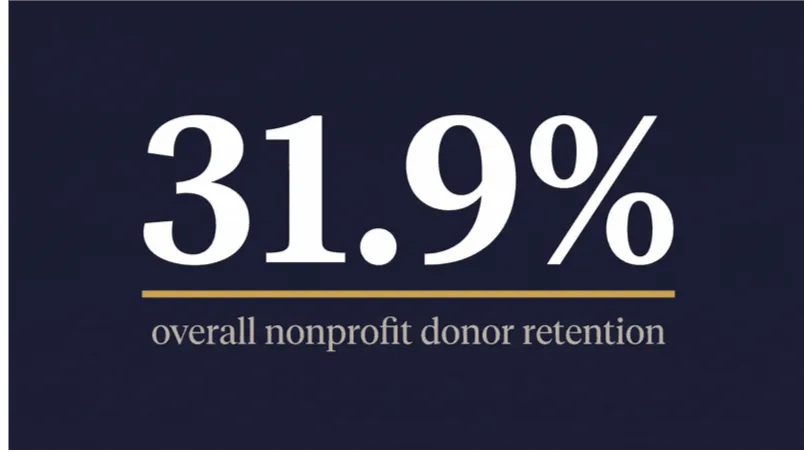
Overall nonprofit donor retention sits at roughly 31.9% as of Q3 2025. That means nearly seven out of ten donors who give this year won’t give again next year. First-time donor retention is even worse, around 18%. For every hundred new donors you acquire, eighty-two of them are already gone.
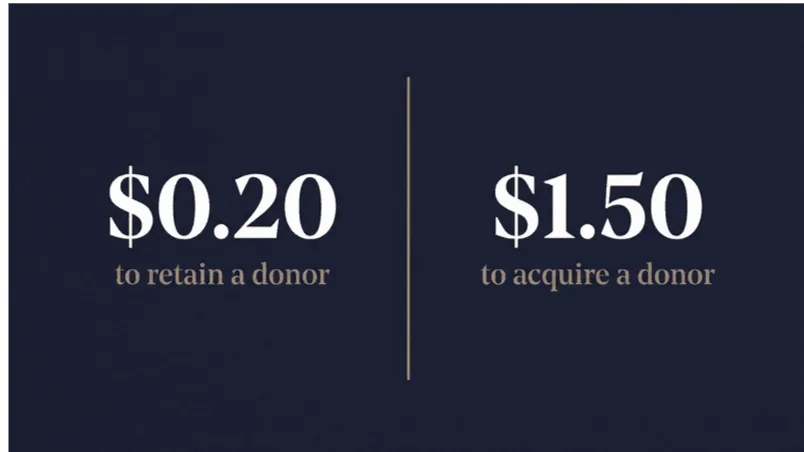
Meanwhile, acquiring a new donor costs five to seven times more than retaining an existing one. The numbers from Neon One’s 2025 Generosity Report are stark: retaining a donor costs $0.20 per dollar raised. Finding a new one costs $1.50 per dollar raised.
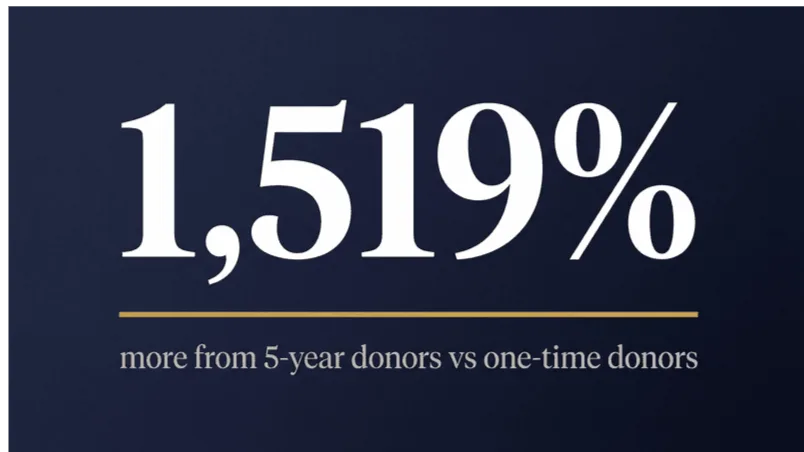
In higher education, the picture isn’t much better. Major donors in the $5K-$50K range saw retention decline by a full percentage point year-over-year, landing at 52%. That might sound acceptable until you realize that donors who give consistently for five years contribute 1,519% more than one-time donors. A retained donor isn’t just slightly more valuable. They’re an entirely different category of supporter.
And yet 60% of new donors don’t return after the first year. Not because they can’t afford another gift, but because they don’t feel seen, valued, or informed. The primary driver of donor attrition isn’t budget constraints. It’s communication breakdowns.
The thank-you letter isn’t a courtesy task. It’s the first step in securing the next gift.
What $10K+ Donors Actually Want
Here’s a hard truth that advancement offices struggle with: donors giving at the major gift level aren’t looking for another plaque.
Sure, they’ll appreciate the naming opportunity. They’ll attend the recognition dinner. But what they really want to know is that their gift mattered to a real person. That it changed something. That someone, somewhere, is better off because they decided to write that check.
The most powerful thank-you letter doesn’t come from the VP of Advancement. It comes from the student athlete who got the scholarship. The head coach who finally has a facility that matches the program’s ambitions. The researcher who can now pursue work that might change how we understand disease, or climate, or human behavior.
When a donor opens an envelope and finds a handwritten note from the person their gift directly helped, something shifts. The relationship moves from transactional to transformational. The donor isn’t just supporting an institution anymore. They’re connected to a human being whose life is different because of their generosity.
This is why 75% of donors want more personalized recognition beyond traditional methods like plaques or certificates. Organizations with strategic donor recognition programs report a 25% increase in donor engagement and 15-25% improvements in donor retention. A 20-percentage-point retention improvement can triple average lifetime donor value, generating $5-$10 for every dollar invested over five years.
The math is unambiguous. The challenge is execution.
The Handwritten Note as Strategic Tool
Let’s be honest about why most advancement offices default to form letters: scale.
Your team is managing hundreds, maybe thousands of donors. The major gifts officer is juggling a portfolio of 150 prospects. The annual giving team is trying to steward 10,000 donors with a staff of three. Asking the head coach to personally write thank-you notes to fifty donors sounds great in theory. In practice, it means those notes either never get written, or they get written three months after the gift when the emotional moment has passed.
But here’s what changed: technology now makes it possible to capture a real person’s handwriting and reproduce it authentically at scale. A head coach can “write” a personal note to every major donor who supported the program this year without spending forty hours at a desk. A scholarship recipient can thank every donor who funded their education without sacrificing study time. The handwriting and tone are genuinely theirs, preserved with enough fidelity that the recipient experiences a personal connection, not a mass mailing.
The ROI Argument
Let’s talk numbers.
A handwritten note (including production, postage, and processing) costs roughly $4. For a major donor who gives $25,000 annually, that’s 0.016% of their gift.
Now run the retention math. If personalized handwritten acknowledgment improves retention by even a few percentage points among major donors, the ROI is overwhelming. One retained $25,000 donor pays for hundreds of notes.
But the real value isn’t just in retained revenue. It’s in relationship depth. A donor who receives a handwritten note from the scholarship student they support is more likely to increase their gift next year. They’re more likely to respond to the next solicitation. They’re more likely to consider a planned gift. They’re more likely to advocate for your institution to their peers.
The handwritten note isn’t an expense. It’s an investment in relationship infrastructure. The broader research on handwritten mail effectiveness bears this out across industries: 37x higher response rates than email, 99% open rates on handwritten envelopes, and $42 ROI per $1 spent on direct mail.
Rethinking Your Stewardship Stack
If you’re running advancement at a university, try a simple diagnostic: pull your last ten major donor thank-you letters and read them as if you were the donor. Do they sound like they were written by a human being, or generated by a system? Do they reference the specific impact of that donor’s gift, or could the same letter go to any donor of any amount? Did they arrive within 48 hours, or three weeks later when the emotional moment had passed? Do they come from the person whose work the gift funded, or from an office the donor has never visited? If the format itself is part of the problem, the page on the proper handwritten letter format walks through the six-part structure most acknowledgment letters fail to honor.
If you’re not happy with the answers, the solution isn’t to work harder. The system is producing receipt-style letters by default because the system is designed for efficiency, not relationship. Breaking that default requires new tools. Not tools that replace human connection, but tools that enable it at scale — see how Stylograph supports university advancement and donor stewardship for the operational pattern most advancement teams use.
Your donors didn’t give to a university. They gave to the people your university serves. Your thank-you letters should reflect that.
For development offices also focused on improving enrollment outcomes, the same principles of authentic personal communication apply. Explore our resources on admissions yield strategies and why students perceive accepted letters as identical.
FAQ
How quickly should a university send a thank-you letter after a major gift?
Within 48 hours. Speed signals that the gift was noticed and valued. An immediate automated receipt is fine for tax purposes, but the personal thank-you should arrive as quickly as possible. For gifts over $10K, a handwritten note within the first week creates a lasting impression.
Who should sign the donor thank-you letter at a university?
For major gifts ($10K+), the most impactful acknowledgment comes from the person closest to the work the gift supports, such as a head coach, department chair, or scholarship recipient, not just the VP of Advancement. When a donor hears from the person their gift directly helped, stewardship becomes personal rather than institutional. For guidance on tone and structure, see our thank-you notes guide.
Does handwritten donor acknowledgment actually improve retention rates?
Organizations with strategic, personalized recognition programs report 15-25% improvements in donor retention. At the major gift level, where a single retained donor can represent tens of thousands in annual giving, even modest retention improvements generate substantial ROI.