A high school senior in rural Ohio checks the mailbox in early April. Inside are five acceptance packets, glossy folders with congratulations letters printed in the same serif font, the same stock photos of campus in autumn, the same cheerful promises of “community” and “opportunity.” She spreads them across the kitchen table. They blur together. Then she notices one envelope feels different. It is a handwritten note from the chair of the biology department at one of the five schools. “We read your essay about your summer research at the marine lab,” it says. “That is exactly the kind of curiosity that thrives here.” Three weeks later, she deposits at that school.
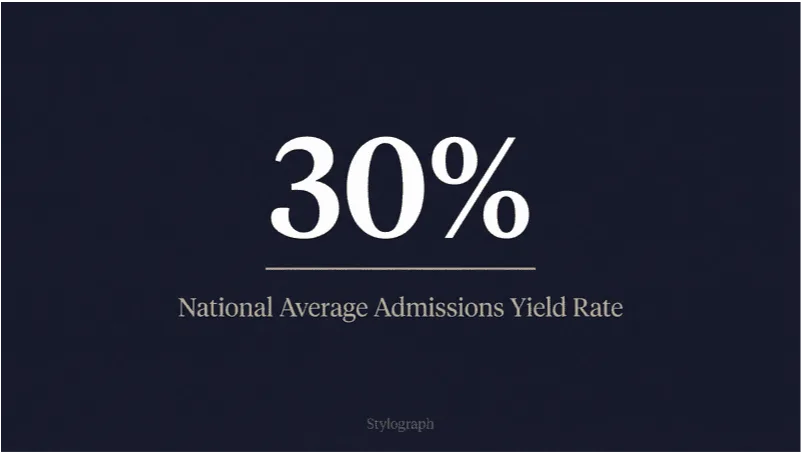
This is the admissions yield problem in miniature. The national average admissions yield rate sits around 30% (approximately 33% for private institutions, 25% for publics), and it has been declining since 2016. For every 10,000 acceptance letters a school sends, roughly 7,000 students choose to go somewhere else. The schools gaining ground are not the ones spending more on viewbooks or email platforms. They are the ones breaking the pattern with personal, tangible, human touches during the critical window between acceptance and May 1.
The Enrollment Cliff Makes Yield the Survival Metric
The demographic cliff is no longer theoretical. High school graduates peaked at approximately 3.9 million in 2025 and are projected to decline 13% by 2041, according to the Western Interstate Commission for Higher Education. NACAC projects 400,000 fewer American high school graduates by 2029. Schools that cannot improve yield will face budget crises, program cuts, and potential closure. More than 120 U.S. colleges have closed or merged since 2016.
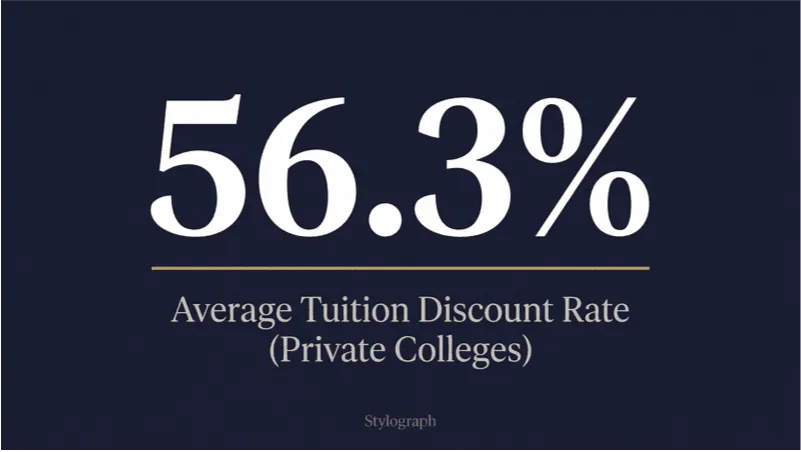
This pressure compounds the yield problem. When the pool of available students shrinks, competition for each admitted student intensifies. Private colleges are already discounting tuition by an average of 56.3% (NACUBO, 2024-25) just to compete on price. When everyone competes on cost, the differentiator shifts to experience and personal connection.
Students Are Comparison-Shopping More Aggressively Than Ever
Common App data shows students submitted an average of nearly seven applications each in 2024-25, up from 6.65 the prior year. Each accepted student is holding multiple offers, comparing financial aid packages, and deciding based on which school makes them feel most wanted.
Consider what this means in practice. A first-generation student in Texas receives acceptance letters from six schools. All six send the standard post-acceptance sequence: welcome email drip, viewbook, financial aid package, admitted student event invitation. The communications are polished but identical in structure and tone. The student cannot distinguish between Institution A’s “We are thrilled to welcome you” and Institution B’s “Congratulations on your acceptance.” Both sound like form letters because they are.
The decision then defaults to price or proximity. But when one school breaks the pattern, when a faculty member in the student’s intended major writes a handwritten note referencing the specific research interest the student mentioned in their application, the decision shifts. The student feels seen, not processed.
The Acceptance Packet Is a Commodity. The Personal Touch Is Not.
Most schools run the same playbook because it is efficient and defensible. Capture Higher Ed lists handwritten notes as one of their top eight yield strategies, recommending enrollment models to identify which high-probability students should receive one. Concept3D recommends handwritten notes after campus visits as a high-impact personalized follow-up. Ravenna Solutions identifies handwritten notes alongside video messages as the antidote to students feeling like “just another number.”
The research is consistent: physical mail cuts through digital noise in ways that email cannot. (For data on response rates and the mechanics of why physical mail outperforms digital outreach, see Does Handwritten Mail Actually Work?) The challenge has never been whether handwritten notes work. It is whether admissions offices can produce them at the scale their yield models require.
Who the Note Comes From Matters as Much as What It Says
A handwritten note from the admissions office is good. A handwritten note from a professor in the student’s intended major is dramatically better. It signals that the academic department knows who this student is and wants them.
The hierarchy of sender credibility looks like this:
- Highest impact: Faculty in the student’s intended major, referencing specific application details
- High impact: Department chairs, program directors, or research mentors
- Moderate impact: Admissions counselors who met the student during campus visits
- Baseline impact: General admissions office correspondence
For student-athletes, a handwritten note from the head coach carries weight that no email template can replicate. The principle is consistent: the further the sender is from “the admissions machine,” the more the note signals genuine, individual interest. (For parallel evidence from collegiate athletics recruiting, see What Top Recruits Actually Remember About the Recruiting Process.)
Institutions further interested in deepening student relationships and family engagement should also explore the parallel strategies outlined in our guides to the 60-day deposit window strategy and the crucial role of authentic donor and family communications.
Summer Melt Is the Silent Yield Killer
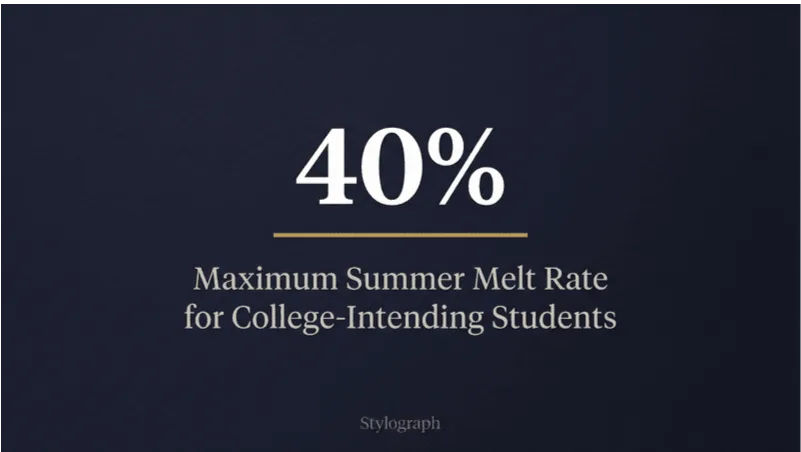
Even after students deposit, the battle is not over. Up to 40% of college-intending students never make it to day one, a phenomenon known as summer melt. InsideTrack research showed that just 2-3 hours of summer coaching increased enrollment by 3 percentage points overall and by 8-12 percentage points among low-income students.
A handwritten welcome note arriving in June or July, after the deposit but before orientation, serves as a tangible anchor during the period when doubt and second-guessing are highest. It extends the personal connection beyond the acceptance letter into the liminal space where students are most vulnerable to changing their minds.
The Scale Objection Is Real, but It Is Also the Opening
The obvious pushback: “We admit 10,000 students. We cannot hand-write 10,000 notes.” That is exactly the point. Schools do not need to write 10,000 notes. They need to write notes to the 500-1,000 students who sit in the movable middle of their yield model, the ones with a 30-60% predicted probability of enrolling who could tip either way with one additional personal touch.
This is where predictive enrollment modeling meets personalized outreach. Admissions teams already know which students are likely deposits (the 70%+ probability group) and which are unlikely (the sub-20% group). The high-leverage work is the middle band. A handwritten note to a student in that band, sent at the right moment, from the right sender, referencing the right details, can move a 45% probability to a 65% probability. At scale, that shift changes enrollment outcomes.
Some admissions teams are already using scaled handwriting technology to produce personalized notes at the volume the movable middle requires, notes that reference specific student interests, intended majors, and application details, written in a faculty member’s actual handwriting, mailed automatically within 48 hours of acceptance. (For context on how to scale personalization without crossing into the uncanny valley of inauthentic communication, see The Uncanny Valley of AI Communication.)
The Strategic Framing
Yield improvement is not about spending more on viewbooks or email platforms. It is about making a small number of students feel individually chosen during the brief window when they are weighing multiple offers. The acceptance packet is table stakes. The handwritten note is the differentiator. Schools that understand this distinction will weather the enrollment cliff. Schools that do not will wonder why their discount rates keep climbing while their yield rates keep falling.
FAQ
What is a good admissions yield rate for a college?
The national average yield rate for four-year colleges is approximately 30%, roughly 33% for private institutions and 25% for public institutions. Elite schools with strong brand recognition may see yield rates of 70% or higher, but the vast majority of institutions operate in the 25-33% range. A “good” yield rate depends on institutional type and selectivity, but any rate above the national average indicates effective enrollment management.
How can colleges improve their yield rate?
Colleges can improve yield by differentiating their post-acceptance outreach from competitors. Key strategies include personalized handwritten notes from faculty in the student’s intended major, targeted communication to the “movable middle” of admitted students (those with 30-60% enrollment probability), summer outreach to prevent melt, and leveraging predictive enrollment modeling to focus limited personal touch resources on students most likely to be influenced by them.
What is summer melt in college admissions?
Summer melt refers to the phenomenon where students who have deposited at a college fail to enroll in the fall. Up to 40% of college-intending students never make it to day one. Melt is particularly high among low-income and first-generation students who face barriers like financial aid verification, housing deposits, and pre-enrollment paperwork. Proactive summer communication, including personalized outreach and coaching, can reduce melt by 3-12 percentage points.
Do handwritten notes improve college enrollment yield?
Yes. Multiple enrollment management research firms identify handwritten notes as a high-impact yield strategy. Physical mail cuts through digital noise that students increasingly filter out. The key factors are sender credibility (faculty notes outperform admissions office notes), personalization (referencing specific student details), and timing (within the acceptance-to-deposit window or during summer melt period). For a practical overview of the handwritten letter process, see our complete guide.