A working five-touch B2B follow-up sequence spreads five contacts across four channels over eighteen days: email on day 1, phone on day 3, LinkedIn on day 7, a handwritten note on day 12, and a decision email on day 18. The channel changes are what make it work, because five emails read as one automated cadence while five different surfaces read as five separate attempts by a real person.
Most follow-up advice stops at “be persistent.” This is the build. Every touch below has a day, a channel, a job, and copy you can adapt in ten minutes.
Key Sequence at a Glance
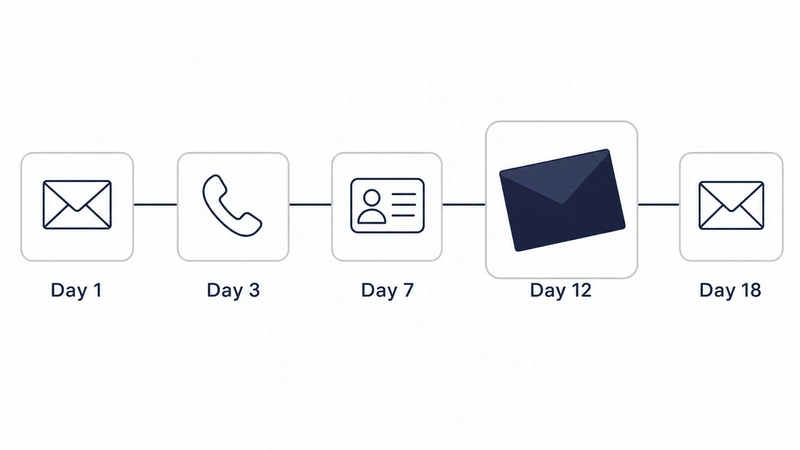
| Day | Channel | Purpose |
|---|---|---|
| Day 1 | State the reason for contact and make one small, specific ask | |
| Day 3 | Phone plus voicemail | Move from asynchronous to synchronous, attach a voice to the name |
| Day 7 | Change the surface, give something, ask for nothing | |
| Day 12 | Handwritten note | Break the digital pattern, land on the desk instead of the inbox |
| Day 18 | Ask for a decision and make “no” an easy answer |
What Does a Complete 5-Touch B2B Follow-Up Sequence Look Like?
Five touches, four channels, eighteen days, with one job per touch and no repetition of channel until the final email. The sequence escalates in commitment, not in volume: it starts with the cheapest channel and ends with the two that cost you the most effort, which is also the order in which prospects find them credible.
Here is each touch with the actual copy.
Touch 1, Day 1: Email
Job: Establish why you are in their inbox and ask for something small enough to say yes to.
Keep this under 120 words, one link maximum, one ask.
Subject: [Their initiative] and the 12 minutes I owe you
Hi [First name],
[Where you came from: we met at X / [Referrer] suggested I reach out / you downloaded Y last week].
[One sentence naming the problem in their language, with a number if you have one.]
[One sentence on a comparable result. No logo dump, no adjectives.]
Worth twelve minutes Thursday or Friday?
[Your name]
The “twelve minutes” is not a gimmick. An odd, specific number reads as a considered request rather than a form field.
Touch 2, Day 3: Phone Call and Voicemail
Job: Attach a human voice to the name in the inbox, and give them a question they can answer in one word.
Call once. If it goes to voicemail, leave twenty seconds, no more.
[First name], it is [Your name] at [Company]. I emailed you Monday about [problem]. I am not chasing a meeting. I have one question about how you are handling [specific thing], and if the answer is “we have it covered,” I will leave you alone. [Phone number]. Again, [phone number].
Then send a two-line email the same hour, because the voicemail alone is not retrievable:
Subject: Left you a voicemail
One question, not a pitch: how are you handling [specific thing] today? A one-word answer is a fine answer.
Touch 3, Day 7: LinkedIn
Job: Prove you exist as a person outside their inbox, and prove it without an ask.
Send a connection request with a note, or comment substantively on something they posted. Do not do both in the same week.
[First name], I emailed you last week about [topic] and I would rather not stay an inbox stranger. I write about [their problem] and I am connecting for that reason, not to pitch you here.
If they accept, do not immediately message a calendar link. That is the single most common way this touch backfires. Send one useful thing with no ask attached, or send nothing and let the sequence continue.
Touch 4, Day 12: Handwritten Note
Job: Break the pattern. Every touch so far has been a screen. This one is an object.
Keep it short. A long handwritten note reads as a form letter that someone paid to have written.
[First name],
We have not connected yet, and I am not going to keep filling your inbox.
If [problem] is on your list this year, I would like fifteen minutes. If it is not, tell me and I will close the file.
[Signature] [Phone number]
Rules that matter more than the copy: handwrite the envelope, use a real stamp, skip the company logo, skip the QR code, and enclose nothing. Anything that makes the piece look like fulfillment undoes the effect you paid for. The reasoning behind this placement is in its own section below.
Touch 5, Day 18: Email
Job: Force a decision by making every possible answer, including no, cost the prospect nothing.
Subject: Closing the loop on [topic]
Hi [First name],
I have reached out a few times about [problem] and have not heard back, which usually means one of three things:
- It is not a priority this year.
- Someone else owns it.
- The timing is wrong but the problem is real.
Any of those is a fine answer. Reply with 1, 2, or 3 and I will act accordingly. If it is 2, who should I be talking to?
[Your name]
Numbered-exit emails work because they lower the cost of replying below the cost of ignoring. A prospect who will not write three sentences will often type a single digit.
How Many Days Should You Wait Between Follow-Ups?
Widen the gaps as the sequence progresses: 2 days, 4 days, 5 days, 6 days. Tight early spacing keeps you in recent memory while your first email is still findable in the thread. Wider late spacing keeps you present without reading as pressure.
Compressed cadences fail for a mechanical reason. When touch 2 lands twenty-four hours after touch 1, the prospect learns the outreach is automated, and everything after that gets filed accordingly. Widening gaps signal the opposite: a person deciding, again, to try. The eighteen-day window also survives a one-week vacation, which a nine-day sequence does not.
The case for running all five touches rather than stopping at two is the data behind the sales follow-up persistence gap: 80% of sales require at least five follow-ups, and only 8% of reps make that many attempts. That post covers why the gap exists. This one covers what to put in it.
Why Does Changing the Channel Matter More Than Sending Another Email?
Because reply rates fall with each additional email in the same channel, while multi-channel sequences outperform single-channel by up to 160%. Your second email competes with your first. A voicemail, a LinkedIn note, and a physical card compete with nothing.
The email math is not in dispute. The average cold email reply rate fell to 5.1% in 2024, and the first email in a sequence draws the highest reply rate at 8.4%, declining with each one after it. Sending touch 4 as another email means sending your weakest asset at the moment you need your strongest. We covered why cold emails keep getting colder separately.
Multi-channel is the correction, and variety is what makes each touch legible as a separate effort rather than another entry in the same thread. 80% of buyers accept follow-ups as long as each message adds value. That test is easier to pass when the format changes, because a new channel carries something the old one could not.
Most cadence templates miss the compounding effect. By day 18, a prospect who ran this sequence has heard your voice, seen your face on LinkedIn, and held your handwriting. Touch 5 is not a fifth email into a dead thread. It is a follow-up to four contacts they can recall. That is the mechanism: touch 4 being physical changes what touch 5 is.
Where Does a Handwritten Note Belong in the Cadence?
Put the handwritten note at touch 4, after the digital channels have gone quiet and before your closing email. It arrives at the exact point where your emails have stopped registering, and it converts your final email from a cold fifth attempt into a follow-up to something the prospect physically held.
The research explains why the physical touch does work a fifth email cannot. Canada Post’s neuroscience study found that physical mail takes 21% less cognitive effort to process than digital media. ANA data shows direct mail generating a 4.4% response rate against 0.12% for email, and paired with email, response rates reach 27%, which is the combination this sequence is built around. The rest of the response-rate and ROI data on handwritten mail sits in one place.
One placement caveat. If your sequence follows a live conversation such as a demo or a discovery call, move the note to touch 2 while the conversation is fresh, where its job is to confirm a connection that already exists. Touch 4 is the placement for sequences that begin cold, where its job is to break a pattern.
The practical obstacle is that nobody writes forty notes a week by hand, so the touch gets cut from the cadence first and then blamed for not working. Stylograph produces handwritten sales follow-up notes in a rep’s own handwriting, with real pen on paper, which keeps touch 4 in the sequence at pipeline volume. The placement logic holds regardless of how the note gets written.
What Do You Send When a Prospect Goes Completely Dark?
Send one message that makes replying free, then change the channel entirely. Silence after real engagement is almost always an internal problem you cannot see, not a rejection you failed to hear.
A deal that was moving and then stopped usually means your contact is losing an internal argument: budget moved, a competing project won the quarter, or the person who signs has not been convinced. They stop replying because they have nothing to report. Give them the artifact that wins the argument, not another request for a call.
Subject: Should I close the file?
Hi [First name],
I do not want to be the vendor emailing into silence. If this is dead, reply “closed” and I will stop.
If it is alive but stuck, tell me what you need and I will build it: a one-page summary for your CFO, the security review, a reference call with someone who has already done this.
[Your name]
Do not send the fake bump (“just floating this to the top of your inbox”), the guilt trip, or the breakup email you do not mean. Reps who send a breakup and then follow up anyway teach the prospect that nothing they say has consequences.
Then switch channels. Post-demo silence and mid-funnel stalls respond to a different surface more reliably than to a better-written email, and deals that go dark tend to revive on the physical touch precisely because it arrives somewhere the silence does not live.
When Should You Stop Following Up?
Stop after touch 5 if you have zero engagement of any kind, and stop immediately if they ask you to. Zero signal across five touches on four channels is a targeting problem, not a persistence problem, and more touches do not fix a bad fit.
Use three rules:
- Explicit no means stop. Log the reason and the date. Do not restart in three weeks with a new subject line.
- Zero signal means stop and nurture. No opens, no connection accept, no callback, nothing. Move them to a quarterly list and reinvest the time in accounts that showed a pulse.
- Any signal means keep going. An open, an accepted connection request, a “not right now”: these are not rejections. Shift to a slower cadence and hold the relationship.
Re-entry should be triggered by events, not the calendar. New funding, a new hire in the role you sell to, a reorganization, or your contact changing companies all give you a real reason to start at touch 1 again. Thirty days elapsing does not.
The reps who beat the persistence gap are rarely the ones sending the most messages. They are the ones whose fifth touch still feels like it came from a person, because the four before it each arrived somewhere different.
FAQ
How many touches should a B2B follow-up sequence have?
Five touches across at least three channels is the working minimum. 80% of sales require five or more follow-ups to close, and multi-channel sequences outperform single-channel ones by up to 160%. A sixth email adds far less than a first phone call or a first physical touch.
How long should a follow-up sequence run?
About three weeks for a cold sequence, with widening gaps: day 1, day 3, day 7, day 12, day 18. Shorter windows read as automated and can be erased by one week of vacation. Longer windows lose the memory of the first touch before the last one lands.
What channels should be in a B2B sales cadence?
Email, phone with voicemail, LinkedIn, and one physical touch. Do not repeat a channel until you have used all of them, because a repeated channel competes with your own earlier message while a new channel does not.
What do you send in a follow-up when there has been no response?
Send a message that makes replying cheaper than ignoring. A numbered-exit email works best: list two or three plausible reasons for the silence, tell the prospect to reply with just the number, and give explicit permission to say no.
Is it worth sending a handwritten note in a sales sequence?
The response-rate data supports it. Direct mail generates a 4.4% response rate against 0.12% for email, physical mail takes 21% less cognitive effort to process than digital, and pairing mail with email lifts response rates to 27%. Placement matters as much as the medium: touch 4 in a cold sequence, touch 2 after a live conversation.
When should you stop following up with a prospect?
Stop when they say no, and stop after five touches that produced no engagement at all. Any signal, including a “not right now,” means move to a slower cadence rather than close the file. Re-enter on a trigger such as new funding or a role change, not a calendar reminder.