A customer brings a three-year-old SUV in for an oil change. The advisor logs the work in 90 seconds. An automated text fires when the car is ready. The customer pays at a kiosk and drives off. Two years later, that same customer trades the SUV in at a different dealership across town.
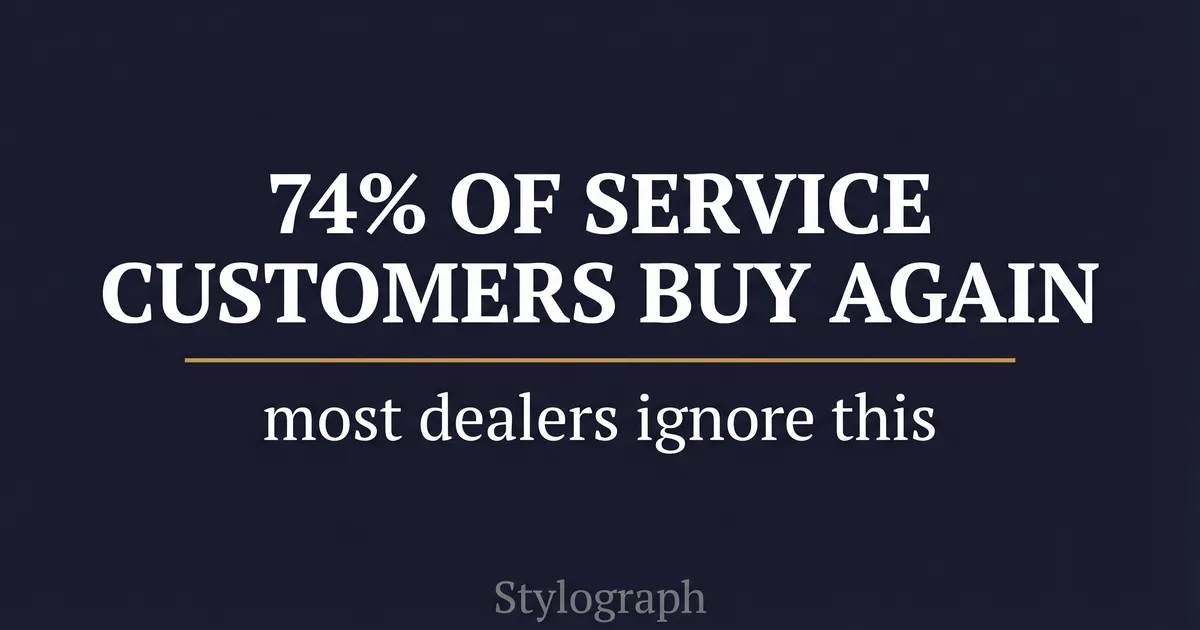
That sequence happens thousands of times a week in U.S. dealerships, and it costs each store more than most general managers realize. Cox Automotive’s 2025 Service Industry Study found that 74% of car owners who service at a dealership are likely to buy their next vehicle there. For owners who service somewhere else, the number falls to 44%. The service drive is the single best predictor of where the next car gets bought.
Most dealers know this in their gut. Almost none operate like it is true.
The service department is your best sales pipeline
Walk into a dealership and ask where the sales pipeline lives. Someone will point at the BDC, the digital lead aggregator, or the floor traffic dashboard. Almost no one points down the hall to the service drive.
That is the gap. Sales and service usually live in different P&Ls, different buildings, and different cultures. Sales chases new ups. Service runs throughput. The two teams rarely share a customer view, and when they do, it lives in a CRM nobody opens.
Meanwhile, the customers in the service drive are the warmest leads in the building. They have already chosen this brand, this dealership, and this staff. They show up on a recurring schedule with a vehicle the store has full data on. The 30-second appointment is also a 30-second window to learn how their commute changed, whether they had a baby, what their lease looks like next spring.
Almost none of that gets captured. The service writer keys in mileage, prints the RO, and moves on.
The math most dealers miss
A typical retail service customer spends in the low thousands at the dealership over a 5- to 7-year ownership window. That is the obvious number. The bigger one sits at the back end.
If 74% of service-loyal customers buy their next vehicle at the same store, and the average front-end gross plus F&I on a new car sits well into four figures, every retained service customer is worth a vehicle deal in expected value. Multiplied across the year, the number on the table is large.
Take a midsize store doing 100 retail service visits a week. Push retention from 54% to 64% on the under-five-year cohort, and you keep roughly 10 customers a week from going elsewhere. That is 500 service relationships a year. At a 74% repurchase intent, that is 370 incremental at-bats on the next vehicle these customers buy. Even a 30% close rate on those at-bats puts more than 100 incremental units a year on the board.
That kind of number pays for a fixed-ops retention program many times over. It is also a number nobody is reporting because the attribution sits across two departments that do not talk to each other.
Why service customers leave (and it isn’t price)
Cox Automotive found that 45% of vehicle owners are dissatisfied with the dealership service experience. The top complaints are unexpected costs and poor communication, not the menu price on the sticker (Cox Automotive 2025). The full picture on why dealership service visits have dropped 12% tracks where this defection is happening month over month.
Translated: customers leave because the service felt impersonal, the bill surprised them, and nobody followed up. Independent shops win on the same vehicle, often at higher labor rates, because the owner picks up the phone, explains the recommendation, and remembers the dog in the back seat from the last visit.
There is a structural reason this happens. A service writer at a high-volume store opens four to six ROs an hour. The advisor’s incentive is throughput. The customer’s experience is being processed. By the time the warranty expires and the customer is no longer obligated to come back, there is no relationship keeping them there.
The shops that retain customers past the warranty cliff are the ones that built a real relationship inside the warranty period. The dealerships that lose customers are the ones that treated the warranty period as captive demand.
What a post-service touchpoint actually looks like
The simplest, cheapest fix is the one most dealers refuse to try: a personal note after the service visit, signed by the advisor or service director.
Not a CSI survey. Not a discount coupon. Not an automated email saying “Thanks for your recent visit.” A short, specific note in someone’s actual handwriting that names the vehicle, references something from the visit, and is signed by a real person on the team.
Cost per note runs $2 to $4 fully loaded. Dealers who run this consistently report two effects. First, recipients call back to thank the advisor, which never happens with a CSI email. Second, the next service appointment gets booked at that store more often than the regional average, a pattern consistent with the broader data on handwritten mail response rates and ROI across customer-facing industries.
That is the unglamorous version of customer experience. Not a kiosk. Not an app. A physical artifact that signals the dealership noticed the person.
Stylograph builds this kind of touchpoint into a fixed-ops workflow. The service department captures each writer’s real handwriting once, then sends a note written with a real pen in that handwriting after each qualifying visit, at the cost of a coffee. The point is not the gimmick of handwritten output. The point is that customers who have spent five years interacting with kiosks and chat windows recognize the difference instantly.
The cadence stays light. A note after a major service. A note when the warranty is 90 days from expiring. A note after a vehicle anniversary. Three or four touches a year, signed by the advisor the customer already knows.
The long game: longer ownership cycles change the math
For most of dealership history, the rule of thumb was that a customer cycled through a new vehicle every three to five years. The relationship had natural recurrence. A failed follow-up only cost a couple of years of disengagement before the customer came back into market.
That window has stretched. U.S. vehicles are being kept longer than at any point on record, which means a customer who walks out of the service bay frustrated may not be in market again for the better part of a decade. The job is no longer to win the next purchase 18 months out. It is to stay in the customer’s life long enough to be the obvious choice when they finally move.
That is why personal communication is the only durable retention tool dealerships still have. Every other lever (price, hours, location, technology) gets matched by competitors quickly. The relationship the customer feels with the advisor, the writer, the service director: that is the asset nobody else can copy.
Bain’s classic work on customer retention found that a 5% increase in retention can produce a 25% to 95% increase in profit, depending on the industry (Bain & Company). Dealerships, with their hybrid service-and-sales economics, sit on the high end of that range. The path to that retention does not run through better software. It runs through a service drive where customers feel known.
FAQ
How does service retention affect vehicle sales?
Cox Automotive’s 2025 Service Industry Study found that 74% of customers who service at a dealership are likely to buy their next vehicle there, versus 44% for customers who service somewhere else. That gap turns the service department into the most concentrated source of warm pipeline a dealership has, even though most stores attribute none of their unit sales to fixed ops.
What is the most cost-effective way to retain dealership service customers?
The most cost-effective tactic is consistent personal communication from the same advisor or service director the customer interacts with at the drive. A handwritten note after a major service visit costs about $4 fully loaded and produces measurable repeat behavior because it signals attention, not automation.
Why are dealerships losing service share to independent shops?
The Cox Automotive data points at experience and communication, not pricing. 45% of vehicle owners are dissatisfied, and the top complaints are unexpected costs and poor communication. Independent shops win because the owner picks up the phone and remembers the customer. Dealerships lose because the throughput model strips out the human touchpoints that build loyalty.
When should a dealership re-engage a service customer to keep the relationship alive?
The two highest-impact windows are right after a major service visit (when the customer still feels something about the experience and is willing to act on that feeling) and roughly 90 days before the manufacturer warranty expires (when customers start reassessing where they will take the vehicle next). Most dealerships miss both windows because the workflow is built around appointment scheduling, not relationship cadence.
The takeaway
The dealerships pulling ahead in fixed ops are not the ones with the most automated service drive. They are the ones that built a service experience where the customer feels remembered. The 74% number is sitting in front of every general manager in the country. Almost no one is operating like it is true.
The store that does is the one that wins the next decade of vehicle sales, because the customer in the service bay this morning is still going to be in market in 2036. The only question is whether they will be back for the test drive at your store, or someone else’s.